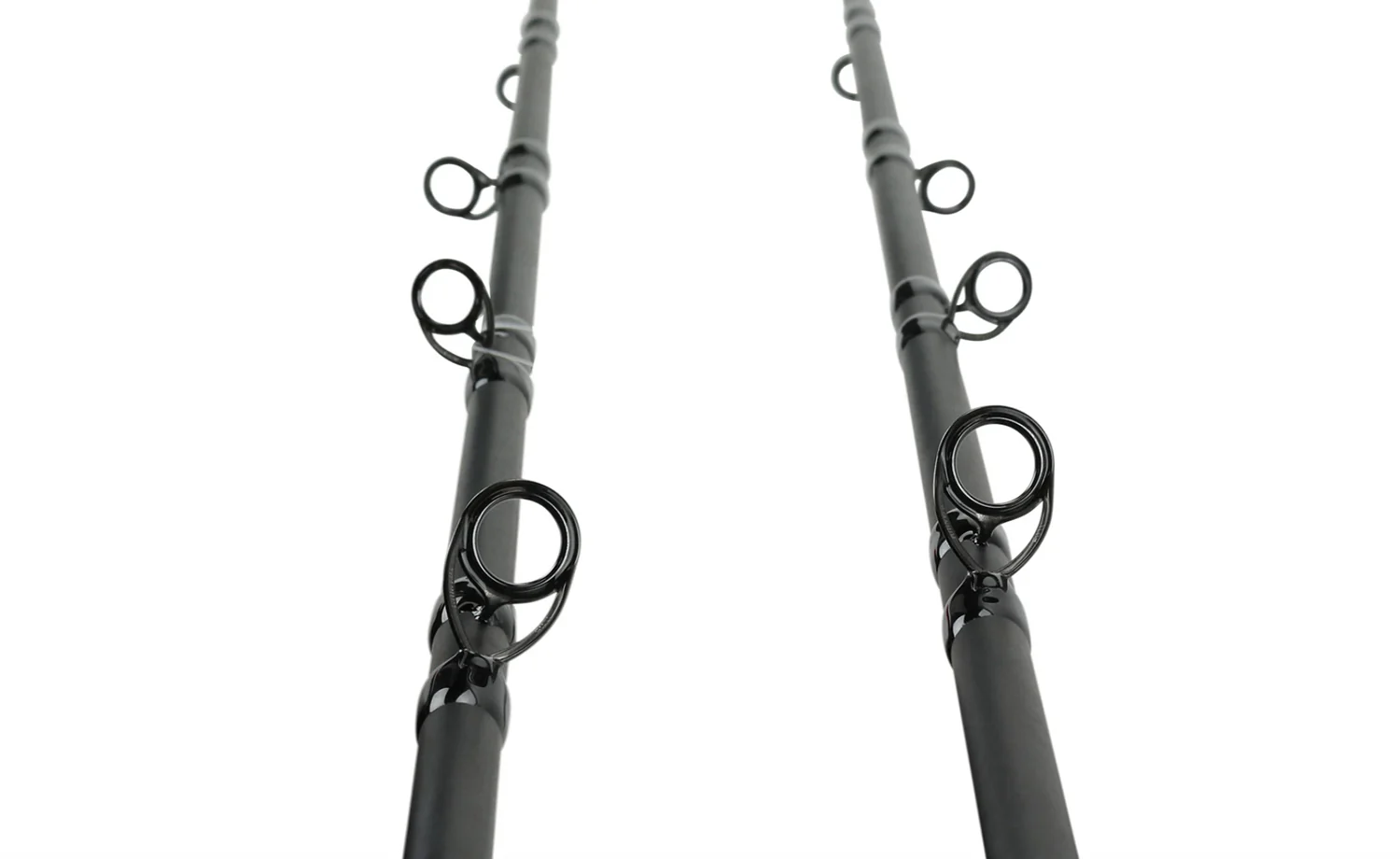
Build a spiral wrap on the wrong rod and you've added complexity for nothing — extra labor, extra cost, a wrap layout that looks broken to anyone glancing at the rack, and zero performance gain. Build a traditional top-guide layout on a rail-fishing tuna stick and you'll spend a 45-minute fight wrestling the blank's torque on top of wrestling the fish.
The technique known variously as the spiral wrap, the acid wrap, and the Roberts wrap has been around for over a century, has been argued about for most of it, and refuses to die out despite mainstream tackle manufacturers ignoring it. Most coverage treats it as a how-to. The recent Mud Hole Custom Tackle piece on setting one up is the latest example. What no one writes is the history — where it came from, who named it, how it spread between coasts and across oceans, and crucially, why it never crossed over into spinning despite a hundred years of opportunity.
That history is the answer to the build question every custom builder eventually faces: should I spiral-wrap this one? The technique has been right for a specific kind of rod, in a specific kind of fishing, since 1909. The geography and the geometry both explain why.
Table of Contents
- The 1909 Patent: John Scanlan
- The Roberts Wrap and the West Coast Acid Wrap Rebrand
- The Mechanical Case: Why It Belongs on Conventional, Not Spinning
- The Geographic Adoption Arc
- Why Mainstream Tackle Manufacturers Still Haven't Followed
- Where Things Stand in 2026
- A Decision Framework for Your Build
- The Bottom Line
1. The 1909 Patent: John Scanlan
The earliest formal record of a spiral wrap is U.S. Patent 919,778, filed in July 1908 and issued April 27, 1909, by John Scanlan. Tom Kirkman — longtime RodMaker magazine contributor and one of the central figures in modern American custom rod building — has noted that Scanlan "may or may not have been the first to use it, or even develop it. But he did patent it."
That distinction matters. The geometry of running line under the rod blank instead of over it isn't an obvious invention so much as a logical consequence of where a top-mounted reel sits and where line wants to go under load. Informal versions of the wrap almost certainly existed in the bamboo-and-cane era before Scanlan filed. What Scanlan did was formalize it on paper, in a form that could be cited later — which, after decades of obscurity, is how the technique entered the historical record at all.
For most of the 20th century, the spiral wrap was a curiosity. Most production fishing rods were built around the assumption that guides go on top. A small number of builders ran spiral wraps for specialized applications — heavy boat rods, trolling setups where the rod sat in a holder for hours — but the technique never threatened the top-guide orthodoxy that the major rod manufacturers and tackle shops had standardized on. It was the kind of thing you'd encounter in a custom builder's shop in a coastal town, not in a Sears catalog.
The revival started in the second half of the 20th century, picked up speed in the 1990s, and arrived in the modern era under three different names — Roberts wrap, acid wrap, spiral wrap. That's partly why the history is hard to track. The technique has been rediscovered enough times that no single rediscovery owns the credit.
What kept it alive through its quiet decades was a small group of custom builders who didn't need a manufacturer to validate the choice. They built spiral-wrapped rods because the rods worked better under load than the alternatives for the kind of fishing they were doing. That's a story we'll return to. First, the names.
2. The Roberts Wrap and the West Coast Acid Wrap Rebrand
The technique runs under at least four names depending on whom you ask: spiral wrap, Roberts wrap, acid wrap, and regional variants like reverse wrap (Custom Angle Rods) and Missouri wrap. Each name carries a story that explains something about how the rod-building community actually adopts (and renames) techniques.
The Roberts Wrap
The first modern-era name was the Roberts wrap, after rod builder Chuck Roberts. RodMaker Magazine's glossary credits him directly: "another term for the spiral wrap named after rod builder Chuck Roberts, another proponent of spiral wrapping for casting rods."
Roberts' contribution was advocacy, not invention. He was working in the 1950s and 1960s — per FlyAnglers Online — when most custom builders defaulted to traditional top-guide layouts and treated spiral wraps as unorthodox. Putting a builder's name on the technique was, in part, a way to give others permission to try it. The naming convention is telling. In a community where a wrap layout gets named after the person willing to argue for it publicly, you can read the temperature of how contested the choice was at the time.
Roberts' specific method — sometimes documented in older sources — placed the first guide (the one nearest the reel) at 0 degrees, the second at 60 degrees, the third at 120 degrees, and the rest including the tip-top at 180 degrees, per Fish Alaska Magazine's account. That progression is the lineage that runs forward into the modern documented methods, even where modern builders have moved to simpler transitions.
Around the same period, Bud Erhardt's Fishin' Sticks — operating out of the Arkansas Ozarks — was producing one of the first commercial spiral-wrapped rod lines. A 2004 rodbuilding.org thread from builder Mark Schulte mentions purchasing an Erhardt rod at a Chicago fishing show "12 or 13 years ago" — which dates Erhardt's commercial spiral-wrapped output to roughly 1991–1992 by Schulte's forum-anecdote estimate. That's the earliest specific date we have on a commercially-marketed spiral-wrapped rod. It's also a reminder that the revival wasn't strictly West Coast: Ozark and Midwest builders, regional tackle shows, and East Coast custom shops were all running parallel experiments before the West Coast renamed the whole thing.
The Acid Wrap
The name that stuck — at least in the West Coast vernacular — wasn't Roberts wrap. It was acid wrap, and the naming origin is one of the best stories in rod building:
"It looks like the rod builder was tripping on acid when he attached the eyes."
The line was attributed to a comment made to West Coast builder Jim Racela in the 1990s, asked whether he was on acid when he wrapped a particular rod in spiral fashion. The name stuck partly because it was funny, partly because it was apt. Guides starting on top, traveling around the blank, ending underneath does look like the work of a builder who got distracted halfway through. Racela became one of the West Coast's identifiable proponents of the technique, and the name traveled with him.
A third West Coast proponent, Darin Dohi, helped push the technique into mainstream tackle awareness by advocating for it to Randy Penny at United Composites. Penny incorporated spiral wraps into UC's product line after Dohi's advocacy, though Penny's primary reputation in the West Coast tuna community is for rail rod design rather than spiral-wrap commercialization specifically. Dohi's account, captured in Salt Water Sportsman's coverage, notes that he "got a reputation for supporting spiral-wrapped rods" — which, in that community, was both a compliment and a warning.
The Documented Methods
What the technique didn't have through this naming-and-renaming era was a single standardized layout. Anyone could call their wrap a spiral wrap, but the actual placement and rotation of guides varied builder-to-builder. That changed in the late 1990s and early 2000s when several builders published distinct methods in RodMaker — Ralph O'Quinn ("Spiral Wrap For Casting Rods"), Rich Forhan ("Revolver Rod"), Tom Kirkman ("Spiral Wrap Transitions"), and Bill Colby ("Simple Spiral / Bumper Wrap"). These were competingdocumented methods, not a joint standardization. There's no single canonical layout for a spiral wrap — there are several documented systems, and most builders today follow one of them.
A summary of the modern lineage:
| Figure | Contribution | Approximate Era |
|---|---|---|
| John Scanlan | First patented spiral wrap (US 919,778) | 1909 |
| Chuck Roberts | Mid-century proponent who revived the technique; "Roberts wrap" naming | 1950s–1960s |
| Bud Erhardt (Fishin' Sticks) | First commercially-marketed spiral-wrapped rods | ~1991–1992 onward |
| Jim Racela | West Coast adopter; "acid wrap" naming origin | 1990s |
| Darin Dohi | West Coast mainstream advocate | 1990s–2000s |
| Randy Penny (United Composites) | Incorporated wraps into UC's product line | 2000s onward |
| Ralph O'Quinn | "Spiral Wrap For Casting Rods" in RodMaker | 1990s–2000s |
| Rich Forhan | "Revolver Rod" method in RodMaker | 1990s–2000s |
| Tom Kirkman | "Spiral Wrap Transitions" in RodMaker | 1990s–2000s |
| Bill Colby | "Simple Spiral / Bumper Wrap" in RodMaker | 1990s–2000s |
What "Spiral Wrap" Means on a Spec Sheet
Because the documented methods are competing rather than canonical, "spiral-wrapped rod" on a commercial spec sheet isn't a precise description. Different manufacturers and custom builders use materially different transition layouts. When evaluating a commercial offering, look for three specific things: the transition zone length (how many guides span the top-to-underside rotation), the guide count in the transition (typically two to three guides at intermediate angles), and the rotational specifics at the butt guide (some methods keep the butt guide at 0°, others rotate slightly).
A builder spec sheet that doesn't specify the method is using "spiral wrap" as marketing language, not engineering language. A spec sheet that names a documented method — O'Quinn, Forhan, Kirkman, or Colby — is doing the work to be precise. Both are legitimate; only one tells you what you're getting.
3. The Mechanical Case: Why It Belongs on Conventional, Not Spinning
The single most important fact about spiral wraps is also the simplest one. Spiral wraps solve a problem unique to conventional and casting rods. They don't apply to spinning rods at all.
Here's the geometry. On a top-mounted reel — a conventional, casting, or baitcasting reel — the line leaves the spool from above the rod blank. Under load (a fish pulling, a heavy lure sinking, a jig being worked), the line wants to follow the shortest path from where it exits the reel to where the fish is. That shortest path is below the rod blank, not above it. The blank is in the way.
A traditional top-guide layout fights this. Each guide pulls the line back up over the top of the blank, against where the line wants to go. The result is torque — a twisting force trying to rotate the rod axially in the angler's hands during a fight. On a light or short rod, the torque is manageable. On a long, heavy rod under serious load, the torque can get unpleasant, then exhausting, then capable of twisting a guide foot loose from the wrap over a long fight.
A spiral wrap solves this by transitioning the line, through three or four guides in the middle section of the rod, from the top of the blank to the underside. Once the line runs under the blank, it's already on the side it wants to be on. The blank stops fighting the line, and the line stops fighting the blank.
The Fisherman's 2026 tog rod buildputs the practical effect plainly: "A spiral-wrapped rod tracks straight up and down. When a fish makes a surge, the rod stays aligned with the line instead of rotating unpredictably."
Why Not Spinning
Now look at a spinning rod. The reel hangs below the blank. The line leaves the spool from under the rod, not above it. The first guide on a spinning rod is already substantially below the blank, and the rest of the guides continue the line on the underside, where it already wants to be.
There's nothing for a spiral wrap to solve on a spinning rod. The mechanical problem doesn't exist. Builders have occasionally experimented with "spinning spiral" or hybrid setups, and the result is invariably either pointless (the line was already going where the spiral was trying to take it) or worse than a normal layout (rotating the line back up to the top introduces friction on every guide).
A side-by-side of the geometry across rod types:
| Rod type | Reel position | Where line wants to go under load | Spiral wrap benefit |
|---|---|---|---|
| Conventional / casting | Top-mounted | Underside of blank | Strong — reduces torque, aligns blank to line |
| Spinning | Bottom-mounted | Underside (already there) | None — problem doesn't exist |
| Fly | Top-mounted | Aligned to cast trajectory, not load path | None — line dynamics differ |
The geometric reason the spiral wrap has been a conventional-rod technique for over a century is right there in the table. No amount of cultural advocacy will change it. The technique doesn't fail on spinning rods because of culture or aesthetics. It fails because there's nothing for it to do.
Where the Geometry Actually Pays Off
Inside the conventional-rod world, the spiral wrap pays off most in three specific situations:
- Heavy load held over long durations. Trolling, deep-jigging, rail-fishing for tuna. The longer the rod is loaded, the more the underlying torque problem compounds.
- Stand-up fights against big fish. Stand-up rods for tuna and billfish keep the angler on their feet and the rod tip up for extended periods. Torque reduction shows up as less arm fatigue and more precise rod control.
- Bottom contact applications. Vertical jigging, slow-pitch jigging, bottom-bouncing for groundfish. The rod is loaded against weight constantly; the wrap keeps the blank oriented to the line.
The applications where it pays off less, even on a conventional rod:
- Light casting rods for short fights. Bass casting, light freshwater, light inshore. The torque problem barely shows up; the spiral wrap's complexity isn't justified.
- Roller guide setups. Roller guides minimize line-on-blank friction regardless of rotation; the wrap's benefit is partly redundant.
The geometry tells you where to use the wrap. The history tells you who figured that out.
4. The Geographic Adoption Arc
The technique exists in 1909, mostly disappears for eighty years, then comes back through a series of regional adoptions that, traced in order, look more like a wave moving across fisheries than a single national trend. Geography mattered here because the wrap spread by builder-to-builder transfer in coastal communities, not by manufacturer distribution. Every regional adoption depended on a builder being physically present to argue for it.
California Offshore (1990s onward)
The modern revival started on the West Coast, specifically in Southern California, around the 1990s. Two fisheries drove it: rail-fishing for tuna out of San Diego–area party boats, and casting for breezing yellowtail in the same waters.
Rail-fishing in particular is unforgiving on traditional rod layouts. The angler braces against the rail with the rod horizontal or angled down, fighting large pelagics that pull hard for extended runs. The traditional top-guide layout fights the angler the entire fight. On a 45-minute fight against a 100-pound bluefin, that torque adds up to real arm and shoulder fatigue. The spiral wrap removes a meaningful portion of that fight-on-top-of-the-fight.
Casting for breezing yellowtail introduced a different argument: that the spiral wrap helped casting distance with heavy lures, because the underslung line had less friction on the cast. The magnitude here is contested. The line still touches every guide on the cast — what changes is the angle of contact, not the contact count, and on a 3-ounce iron the gain is measured in inches per cast, not feet. Builders who claim a 10-foot distance gain are overstating; builders who claim "no gain" are understating. The honest answer is "small but real." That was enough to anchor the technique in the West Coast custom community.
West Coast Bottomfishing (2000s onward)
From California, the technique moved north — into Oregon and Washington for salmon and steelhead conventional setups, then British Columbia and Alaska for halibut, lingcod, and rockfish bottomfishing. The Alaskan application is documented in Fish Alaska Magazine, which has run multiple how-to pieceson spiral-wrapped rods specifically for West Coast bottomfishing. Their editorial position on why manufacturers haven't followed is worth quoting:
"Rod builders have been making them for at least 100 years, but despite some strong advantages to spiral-wrapping a casting or conventional rod, they have never caught on with manufacturers, or many angling consumers."
The same Fish Alaska piece adds the most direct statement on slow-pitch adoption: the technique is "fueled in part by the slow-pitch jig community, which has embraced spiral-wrapped rods to a greater degree than other market segments."
The gap between custom-builder consensus and mass-market production is the technique's defining commercial feature, and we'll return to it in section 5.
Slow-Pitch Jigging (2000s in Japan, 2010s international)
The vector that took the spiral wrap international wasn't American. It was slow-pitch jigging, a technique that originated in Japan in the early 2000s — credited to Japanese anglers including Yoshikazu Fujioka and Norihito Sato — and that depends on loading the rod specifically to spring the jig back up the water column. Slow-pitch rods are typically short (6 to 7 feet), moderate-to-slow action, and built for a very specific style of rod manipulation that requires the blank to stay precisely oriented to the line during every cycle.
Spiral wraps fit slow-pitch jigging almost perfectly. The blank stays aligned to the line, the torque problem doesn't interrupt the rod's loading cycle, and the technique's narrow, deep application falls clearly on the function side of any function-versus-aesthetics tradeoff.
Slow-pitch spread from Japan to Australia and New Zealand offshore communities through the 2010s, then to the United States — particularly the offshore charter community in Florida, the Gulf, and California. Each region picked up the spiral-wrap convention along with the technique.
US Northeast (2010s–2020s)
The most recent regional adoption is the Northeast US groundfish community. Salt Water Sportsman quotes rod builder Kim noting that "spiral-wrapped rods are growing popular with Northeastern anglers bottom bouncing for flounder." The Fisherman magazine's 2026 rod-building series included an entire piece on a spiral-wrapped tog rod build, framed as a now-mainstream-enough choice for serious blackfish anglers.
Tog and flounder fishing share characteristics with West Coast bottomfishing — heavy weight, constant blank load, bottom contact, fights that can pull the rod into awkward angles in close-quarters boat-rail situations. The spiral wrap solves the same mechanical problems in a different ocean.
The Pattern
What jumps out about the arc is that the technique didn't spread by marketing push. It spread because the same mechanical problem kept showing up in different fisheries, and once one regional builder community solved it with a spiral wrap, neighboring fisheries adopted the solution as soon as they hit the same problem. The wrap didn't sell itself through advertising. It sold itself through fight outcomes.
5. Why Mainstream Tackle Manufacturers Have Been Slow to Follow
Here's the question every builder eventually asks: if the technique works as well as proponents claim, why aren't the major rod brands building spiral-wrapped rods at scale?
The answer is more nuanced than "they haven't." Some mainstream-adjacent manufacturers have: Okuma builds spiral-wrap setups into its GLS Steelhead casting rods and Tesoro slow-pitch jigging rods; Yong Yan's Jigging World in New Jersey has built its entire conventional line around spiral wraps; United Composites has been producing them at moderate scale since Darin Dohi's advocacy pushed Penny in that direction. The technique has real mainstream production presence — just not in the mass-market tackle aisle.
So the better question is: why hasn't the mass-market followed? There are two answers — call them the shelf-appeal problem and the production-economics problem — and both are worth understanding before deciding whether to build one for a customer.
The Shelf-Appeal Problem
A spiral-wrapped rod looks strange. Guides starting on top, traveling around the blank, ending underneath — to a casual angler scanning a rack of rods, it looks broken. The Fisherman's 2026 tog rod feature acknowledges this directly: "There's no denying that a spiral-wrapped casting rod looks different. Guides starting on top and ending underneath the blank still draw comments at the dock. But custom rod building has always been about function first."
For a mass-market manufacturer, "looks broken at first glance" is a serious commercial problem. Mass-market shoppers move down a rod rack quickly. A wrap that needs an in-store explanation before the customer will pick it up loses prospective buyers before the conversation starts. Retail tackle staff aren't usually equipped to give that explanation well — and even when they are, the rod still has to compete on shelf appeal with adjacent options the customer already understands.
Mass-market tackle is sold on three-second rack browsing. Custom rods are sold on builder consultation. The spiral wrap is a custom-rod technique partly because the custom-rod sales context tolerates an explanation.
The Production-Economics Problem
The less romantic and probably more important reason is that spiral wraps are harder to manufacture at scale. Each rod needs its blank spine-found, its guides individually placed at specific rotational positions through the transition zone, and quality-controlled for guide alignment at multiple axial points. None of that fits a high-throughput automated wrapping line the way a uniform top-guide layout does.
For a mass-market brand, building 50,000 traditional-wrap rods is cheaper, faster, and easier to QC than building 50,000 spiral-wrapped rods. For a custom builder making 50 rods a year, those production economics don't apply at all.
This is the deepest reason the technique stays custom. The production economics structurally favor traditional layouts at every scale above a few hundred rods per year. The custom-build sector is the only sector where the production-cost penalty of a spiral wrap is borne by the builder voluntarily, in exchange for the build's specific performance gain.
A handful of smaller, specialized brands — Okuma (with specific spiral-wrap product lines), Jigging World, United Composites, plus West Coast and Northeast custom shops and imported Japanese slow-pitch specialty makers — do produce spiral-wrapped rods at moderate commercial scale. They've found their margin in being the manufacturer that won't compromise on the wrap. That's a different business model than the mass-market tackle brands, and it's why the spiral wrap remains, structurally, a custom-builder and specialty-manufacturer technique even where production builders pick it up.
6. Where Things Stand in 2026
The current state of the spiral wrap is healthy in three communities and quiet in the rest of the rod-building world.
Strong in slow-pitch jigging, where the wrap fits the technique so well that newer American slow-pitch builders treat it as more or less a default choice. Steady in West Coast offshore conventional builds, where the rail-fishing and tuna fight tradition has kept the wrap continuously in use since the 1990s. Growing in Northeast groundfish rods, where The Fisherman's 2026 rod-building coverage, rising tog/flounder demand, and specialty makers like Yong Yan's Jigging World have made the wrap a recognized choice rather than an oddity.
Largely absent from the bass-casting world, despite a small handful of vocal proponents over the years. Absent from fly fishing entirely, where the geometry doesn't apply. Absent from spinning, for the geometric reasons covered above. And still absent from mass-market tackle production, for the commercial reasons covered above.
The May 2026 Mud Hole Custom Tackle piece on setting up a spiral wrap guide train, authored by Chris Adams, is a useful marker for where 2026 sits: the largest custom-rod-supply retailer in the country running a tutorial on the technique, in a publication aimed at home builders, in a tone that assumes the reader will at least consider the wrap for their next build. That would have been an unusual editorial choice fifteen years ago. In 2026, it's mainstream-custom.
Beyond Mud Hole, the spiral-wrap conversation in 2026 is moving along three tracks. Within slow-pitch jigging, technique-specific guide systems and components are being designed around the spiral-wrap assumption. Within Northeast groundfish, the wrap is gaining ground as standard practice on serious blackfish and tog builds. And within the rest of conventional rod building, the wrap remains a builder's-choice technique applied selectively to the builds where the geometry actually pays off.
That selective application — neither universal nor obsolete — is roughly where the technique deserves to be.
7. A Decision Framework for Your Build
When a customer or your own next build raises the question — spiral-wrap this one? — walk through these five steps in order. The answer falls out.
- Is it a top-mounted reel (conventional, casting, baitcasting)? If no — stop. Geometry doesn't help. Skip the wrap.
- Will the rod sit under continuous load for more than ~30 seconds per fight? Tuna, bottomfishing, jigging, trolling, tog: yes. Bass casting and short-fight inshore: usually no. If no, the torque problem barely shows up and the wrap's complexity isn't worth the labor.
- Is it bottom-contact (jigging, bottom-bouncing) or stand-up offshore? Yes → strong fit for a spiral wrap. The continuous-load and orientation-sensitivity arguments compound.
- Are you using roller guides? Yes → the wrap's friction benefit is partly redundant. Build the wrap if torque reduction still matters for the application; skip it if rollers are doing the work.
- Is it a light bass or inshore casting build? Yes → skip. The mechanical case is too thin to justify the production cost and the shelf-appeal penalty if you ever resell.
A "yes" on steps 1, 2, and 3 is a strong candidate for the wrap. A "yes" on step 4 calls for judgment. A "yes" on step 5 means stick with a traditional top-guide layout.
8. The Bottom Line
Knowing when a spiral wrap belongs on a build — and when it doesn't — is the difference between a builder who follows trends and one who reads geometry. The wrap has been right for a specific set of conventional builds since 1909, and it hasn't been right for everything else. The history, the names, and the regional adoption arc all point to the same answer the geometry has been quietly giving the whole time.
