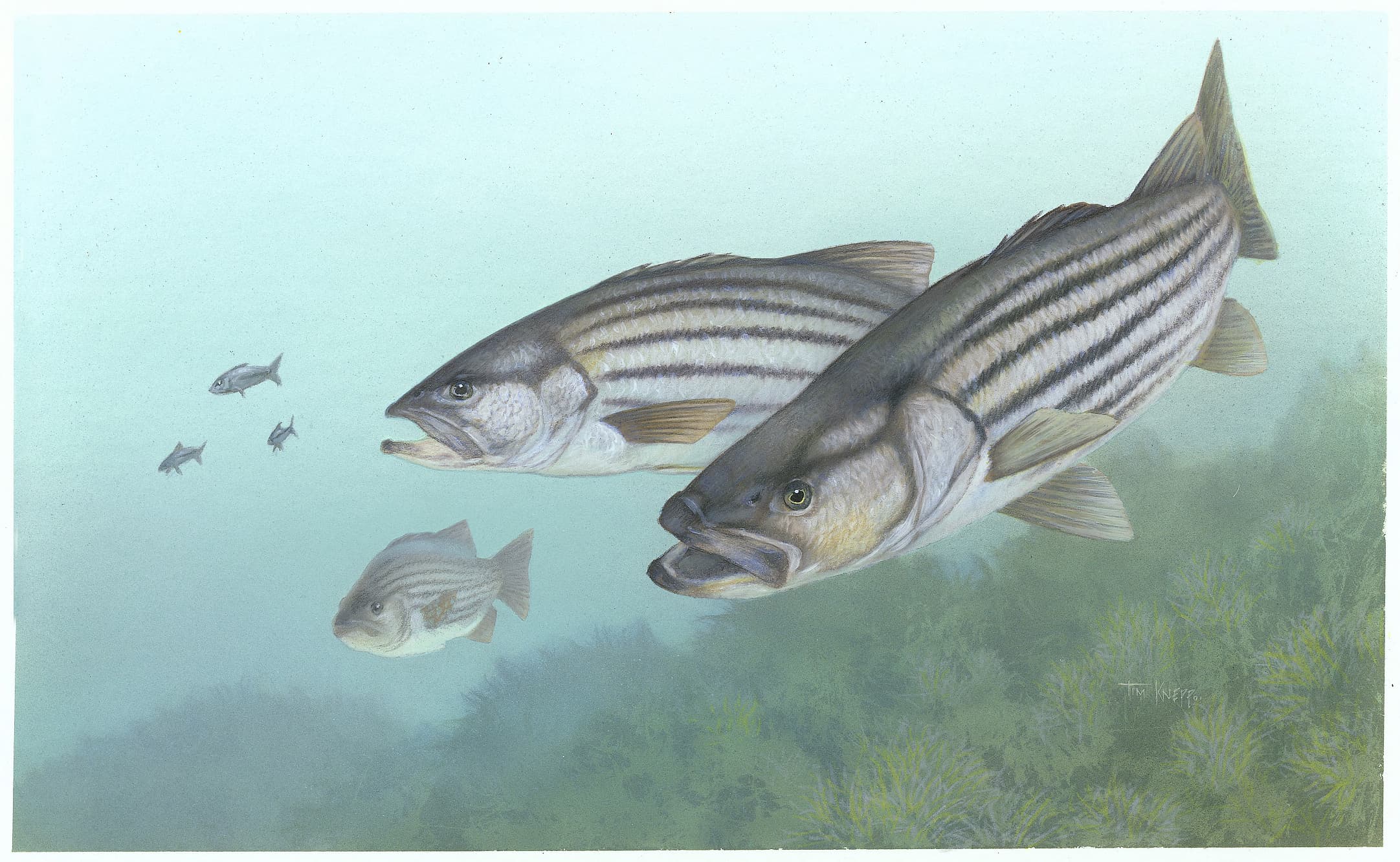
Article Image of Atlantic striped bass (Morone saxatilis). Illustration: Timothy Knepp / U.S. Fish & Wildlife Service (public domain).
Update, October 2026: At its August 6 meeting, ASMFC's striped bass management board adopted no new measures, and the peer review of the next benchmark stock assessment moved to late May or early June 2027 (ASMFC 2026 Summer Meeting summary). The FY2025 fishery management plan review puts 2025 releases at 11.6 million fish, with about 1.0 million of them dying. The rest of this piece reads as it did on July 6.
In 2024, anglers released an estimated 19.1 million Atlantic striped bass, and about 1.7 million of them died anyway, according to ASMFC's Draft Addendum III. Those release deaths made up roughly four in ten of the 4.1 million stripers removed from the stock that year, per ASMFC's August 2025 board presentations. The coastwide rule aimed at those deaths is the circle hook requirement for bait. The newer science says most of what decides whether a released bass lives sits outside it.
Why release survival matters
ASMFC's striped bass page lists the coastwide stock as overfished, and for seven straight years the Chesapeake Bay, the nursery that produces most of the coast's stripers, has spawned poorly. Managers are trying to rebuild the stock by 2029, and Draft Addendum III gives that roughly a 30 percent chance at current fishing levels. For 2026 they weighed tighter limits again and held at the current rules.
With that many fish caught and let go, release survival is one of the biggest levers managers have. ASMFC's working estimate is that about 9 percent of released striped bass die. Circle hooks were supposed to bring that down, which is why ASMFC's Addendum VI requires them for bait fishing coastwide. Ric Burnley's Salt Water Sportsman piece on post-release mortality covers the management side well: the ASMFC work group, the 2029 deadline and the talk of no-targeting closures. The open question is what actually decides whether a released fish swims away.
What the circle hook rule rests on
The mandate rests mostly on Maryland work from the late 1990s and early 2000s. In Maryland DNR's 1999 catch-and-release study, Lukacovic and colleagues found that 17.2 percent of striped bass were deep-hooked on J-style bait hooks, against 3.4 percent on circles. Deep-hooked fish died at 53.1 percent on J-hooks and 23.5 percent on circles. That's a big difference, and it's the reason the rule exists.
In 2024 the Massachusetts Division of Marine Fisheries ran the comparison again with current hooks. The study, by Dean and colleagues, was published in Marine and Coastal Fisheries. Over two years, DMF biologists caught 716 striped bass on J-hooks and three popular circle hook models, fitted about half of them with transmitters that tracked tail beats, and followed survival for two months after release. Their summary: "Surprisingly, we found no significant difference in mortality between any of the circle hooks and J-hooks."
Part of the gap is probably the hooks themselves. Modern circles have wider gaps than the ones Maryland tested, so they behave more like J-hooks. Bait may matter too. The Maryland work used cut menhaden, and many of the Massachusetts fish were caught on live mackerel, which bass take differently.
The 9 percent figure is also being reworked. It's one coastwide number applied to every season and water temperature. A Patuxent River tagging study run by George Mason University, the University of Maryland Center for Environmental Science and The Nature Conservancy, with the Coastal Conservation Association, is measuring it again. Meanwhile the same Massachusetts DMF program, in a preprint by Dean, Gahagan, Hoffman and colleagues that hasn't yet been peer-reviewed, puts average release mortality closer to 4 percent.
A fish no single state can manage
Striped bass migrate from Maine to North Carolina, so a fish spared in Massachusetts can be landed in New York a season later. A state that tightens its rules is partly growing fish for its neighbors, which is a hard sell to its own anglers and commercial fleet. That pull helped drive the collapse of the 1970s and early '80s. The first interstate plan, in 1981, could only recommend measures, as ASMFC's Amendment 7 recounts. Charles Witek, writing for the Marine Fish Conservation Network, called that arrangement a "toothless debating society."
The Atlantic Striped Bass Conservation Act of 1984 changed it by letting the federal government close the fishery in any state that didn't adopt the coastwide plan. States moved together, Maryland imposed a full Chesapeake moratorium, and the stock was declared recovered in 1995.
The modern version of the gap is conservation equivalency, which lets a state swap in its own rules if they're judged equivalent to the coastwide standard. Amendment 7 calls the result an "essential tension." When Addendum VI called for an 18 percent coastwide cut, five jurisdictions used conservation equivalency, and the ASMFC technical committee's 2020 analysis projected the actual reduction at 15 percent, with the odds of hitting the fishing mortality target down from 50 percent to 42. Amendment 7, adopted in 2022, bars conservation equivalency for most recreational fisheries while the stock is overfished. Coordinated rules that every state has to follow are what rebuilt this fishery the first time.
Three things the rule doesn't cover
Set the circle-versus-J question aside, and the newer evidence points at three things that move release mortality and that the hook rule doesn't touch.
Treble hooks
The rule is strict about bait: circle hooks only, with J-hooks and trebles both off the table. DMF notes that the rule still does some good by keeping trebles off bait. It says nothing about artificials, though, so a plug hung with two or three trebles is legal under the coastwide rule. In the Massachusetts preprint, lures with a single hook had the lowest release mortality of any setup. Early results from the program's volunteer anglers, reported by Willy Goldsmith in On The Water, pointed at the number of hooks more than their shape: plugs carrying several hooks did more damage whether those hooks were singles or trebles. Put that next to the finding of no significant difference between circles and J-hooks, and the rule is strictest about the hook choice that seemed to matter least.
Fight and handling time
Griffin and colleagues, researchers from UMass and Massachusetts DMF writing in Fisheries Management and Ecology in 2024, measured blood-chemistry stress in 95 striped bass caught on spin and fly tackle off Massachusetts in 2010 and 2011. Stress indicators rose with longer fights, and water temperature also influenced stress. That study measured stress in the blood; it didn't track whether those fish later died. The Massachusetts tagging work did track deaths, and DMF's preliminary analysis tied survival to hook location, water temperature and handling time.
Fight time is the one factor that runs through the rod itself. A blank with enough power for the fish you're targeting brings a bass in sooner, and an undergunned rod stretches a short fight into a long one. Handling is on the angler. The less time a fish spends out of the water and in your hands, the better its odds.
Summer heat
The same Maryland DNR study shows how hard heat hits. In July, shallow-hooked fish died at 0.8 percent when the air was below 95°F and at 17.2 percent when it was 95 to 105°F. Deep-hooked fish on J-hooks died at about 50 percent. Maryland DNR's 2026 notice on high temperatures puts the danger line at water above 80°F or air above 95°F. Against a coastwide 9 percent, or the 4 percent in the preprint, a midsummer release in shallow Bay water is a much worse bet.
Maryland's 2026 season announcement brings back April catch-and-release, drops the old spring and late-July closures, and closes all of August to targeting striped bass, which puts the no-targeting window on the hottest water. Virginia's harvest season also leaves out the summer, running May 16 to June 15 and October 4 to December 31 under Virginia regulation 4VAC20-252-80.
Setting up for summer stripers
If you fish plugs for stripers, cut the hook points. Swap trebles for single inline hooks, pull the belly hook on plugs that swim without it, and reach for a jig, soft plastic or fly when the bite allows. It costs a few dollars a plug and an evening with split-ring pliers, and some plugs swim differently afterward, so check each one alongside the boat before you trust it. Build or buy with enough power to finish a fight quickly for the size of bass you expect, even if that takes a little sport out of schoolies. Keep fish in the water when you can and have the pliers out before the fish reaches the boat. When the water's over 80°F or the air is pushing 95°F, fish at first light or leave the stripers alone until it cools off.